The Complete Masterclass: Unlocking Unbeatable ROI with Strategic Email Marketing
Email marketing is the cornerstone of digital marketing strategy—a direct, personalized, and high-ROI channel for nurturing leads, driving sales, and building lasting customer relationships. Discover what makes it indispensable.
Advantages of Email Advertising
In the ever-evolving digital ecosystem, where algorithms change and trends fade, one channel remains a constant, powerful engine for growth: email. But what truly is email marketing, and why does it command an average ROI of $36 for every $1 spent? This definitive guide cuts through the noise, offering a 7000-word masterclass that will transform you from a beginner to an email marketing pro. We’ll explore its core purpose, dissect its various forms, and deliver actionable email marketing campaign best practices, with special insights for niches like asset management firms and vibrant markets like email marketing Sri Lanka and email marketing India.
Chapter 1: The Foundation - Understanding the Core
What is Email Marketing? Defining the Engine
To explain email marketing in its simplest form, it is a direct, digital communication strategy that uses email to promote products, services, or ideas, while simultaneously cultivating relationships with an audience that has explicitly permitted this contact. It’s a dialogue, not a monologue. The purpose of email marketing extends far beyond simple promotion; it is a multifaceted tool for:
Building and Nurturing Relationships: Moving strangers to subscribers, subscribers to customers, and customers to advocates.
Driving Sustainable Revenue: Through targeted promotions, abandoned cart reminders, and customer reactivation.
Establishing Authority and Trust: By delivering consistent, valuable content that positions your brand as a leader.
Personalizing the Customer Journey: Offering tailored experiences based on user behavior and preferences.
This is the essence of the email marketing meaning. It’s a permission-based marketing channel you own and control.
Email Marketing vs Newsletter: Understanding the Spectrum
A critical distinction lies in email marketing vs newsletter. Think of it as a square-and-rectangle relationship.
A Newsletter is a type of email marketing. It’s typically a regularly scheduled (e.g., weekly, monthly) digest of content—company updates, blog posts, industry news—primarily focused on engagement and education.
Email Marketing is the overarching discipline. It includes newsletters but also encompasses automated transactional emails (order confirmations), behavioral trigger campaigns (browse abandonment), promotional blasts (sales announcements), and lifecycle nurture sequences (onboarding series).
All newsletters are email marketing, but not all email marketing is a newsletter.
The Undeniable Advantages of Email Advertising
Why invest time and resources? The advantages of email advertising are compelling:
Unmatched ROI: Consistently the highest-return channel in digital marketing.
Direct Access & Ownership: You own your list; you’re not at the mercy of a social platform’s algorithm.
Hyper-Personalization & Segmentation: Enables target email marketing at an individual level.
Measurability: Every aspect—opens, clicks, conversions—is trackable and optimizable.
Drives Action: A focused call-to-action in an email can lead directly to a sale, sign-up, or download.
Automation & Scalability: Set up sophisticated, personalized journeys that work for you 24/7.
Chapter 2: Strategy First - Goals, Audience, and Infrastructure
Defining Your North Star: Email Marketing Goals and Objectives
Every campaign must begin with a clear "why." Your email marketing goals and objectives should be SMART (Specific, Measurable, Achievable, Relevant, Time-bound). Common objectives include:
Lead Generation & Nurturing: Convert subscribers into qualified leads.
Sales & Revenue Generation: Promote products/services to drive transactions.
Customer Retention & Loyalty: Increase lifetime value through engagement and exclusive offers.
Brand Awareness & Authority: Keep your brand top-of-mind with valuable content.
Website Traffic Generation: Drive a consistent stream of engaged visitors to your site.
The Bedrock: Your Email Marketing Address and List Health
Your email marketing address (the "From" address) is a critical brand touchpoint. It should be recognizable and trustworthy, like team@yourbrand.com or news@yourbrand.com. Never use a generic, non-branded address (e.g., Gmail, Yahoo). This builds legitimacy and improves open rates.
A common question is how many emails you should send. There’s no universal answer, but the guiding principle is consistency and value. Sending one highly valuable email per week is better than three mediocre ones. Test and let your audience’s engagement metrics guide your frequency.
Is Email Marketing Worth It? The Resounding Verdict
Is email marketing worth it? The data provides a definitive yes. Beyond the stellar ROI, it’s a direct line to your most engaged audience. For email marketing for businesses of all sizes, it represents a low-cost, high-impact channel that facilitates direct conversation, gathers first-party data, and builds a tangible asset—your subscriber list. It is the cornerstone of a mature digital strategy.
Chapter 3: The Tactical Toolkit - Campaigns, Skills, and Execution
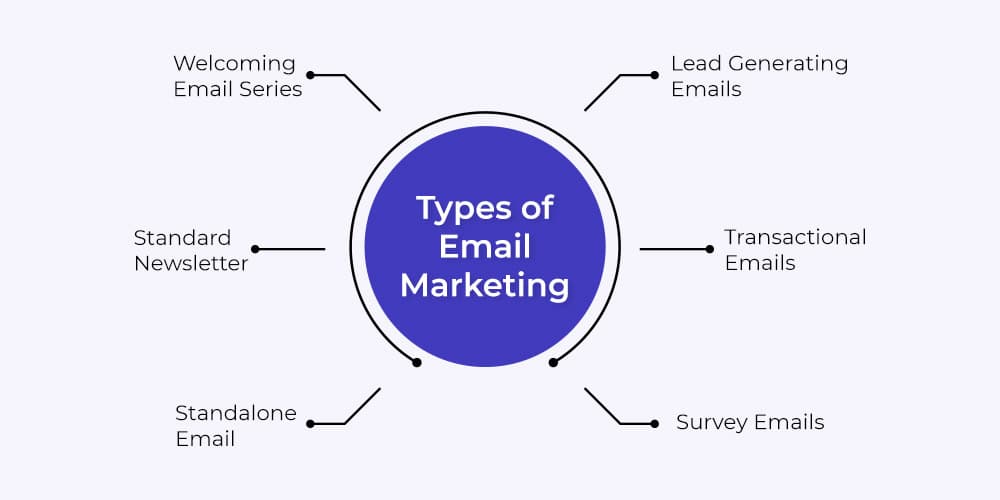
Exploring the Different Types of Email Marketing
Understanding the different types of email marketing allows you to match the campaign to the goal:
Welcome Series: An automated sequence for new subscribers, setting expectations and delivering immediate value.
Newsletters: Regular content-driven updates to inform and engage.
Promotional Campaigns: Direct-sales emails for product launches, sales, or offers.
Transactional Emails: Triggered by user action (e.g., purchase confirmation, password reset). These have high open rates and are crucial for experience.
Lifecycle & Drip Campaigns: Automated educational or sales-nurture sequences based on time or behavior.
Re-engagement Campaigns: Targeted efforts to win back inactive subscribers.
The Art of Email Deployment
Email deployment is the process of sending your crafted campaign to your list. Best practices include:
List Segmentation: Sending the right message to the right segment is the heart of target email marketing.
Timing Optimization: Test different days and times for your specific audience.
Technical Checks: Ensure links work, images load, and the email renders on all devices and clients.
Compliance: Always include a clear unsubscribe link and your physical mailing address (CAN-SPAM/ GDPR/ etc.).
Building Your Skill Set: For Pros and Beginners Alike
For those exploring email marketing jobs with no experience, the path is accessible. Essential email marketing skills include:
Copywriting: Crafting compelling subject lines and body copy.
Basic HTML/CSS: For troubleshooting and customizing templates.
Data Analysis: Interpreting metrics to guide strategy.
Audience Segmentation: Understanding how to group subscribers.
Automation Workflow Design: Mapping out customer journeys.
Design Sensibility: Creating visually appealing, on-brand emails.
Platforms like HubSpot, Mailchimp, and Klaviyo offer certifications that can bolster a resume for entry-level positions.
Chapter 4: Industry and Regional Deep Dives
Email Marketing Tips for Asset Management Firms (A Specialized Approach)
For asset management firms, email marketing is less about promotion and more about trust, education, and transparency. Key strategies include:
Prioritize Educational Content: Share market commentaries, whitepapers, investment philosophy insights, and regulatory updates. Position yourself as a guide, not a salesperson.
Segment with Precision: Communicate differently to high-net-worth individuals, institutional investors, and professional advisors.
Emphasize Compliance & Clarity: All communications must be meticulously vetted for regulatory compliance. Transparency is non-negotiable.
Focus on Retention: Use email to deliver consistent value to existing clients, reinforcing their decision to trust you with their assets. This is a prime example of sophisticated email marketing for businesses in a trust-driven field.
Localizing Strategy: Email Marketing Sri Lanka & India
Success in markets like email marketing Sri Lanka and email marketing India requires cultural and technological nuance:
Mobile-First is Non-Negotiable: Over 90% of emails in these regions are opened on mobile. Designs must be responsive, lightweight, and thumb-friendly.
Language and Cultural Resonance: While English is widely used, incorporating local languages (Sinhala, Tamil, Hindi) or culturally relevant themes can dramatically increase engagement. Consider separate lists or dynamic content.
Value-Driven Offers: Content and promotions should solve local problems or align with regional aspirations. Practical tips, local success stories, and hyper-relevant offers win.
Festival & Seasonality Campaigns: Aligning campaigns with festivals like Diwali, Ramadan, Sinhalese & Tamil New Year, or Pongal shows cultural understanding and drives exceptional results.
Building Trust: In growing digital economies, clear privacy policies, authentic sender names, and valuable content are key to building a reputable list.
Chapter 5: The Pro Playbook - Best Practices for Unbeatable Campaigns
Here are the consolidated best tips for email marketing that every pro swears by:
Master the Subject Line and Preheader: This is your gatekeeper. Create curiosity, state a benefit, or invoke urgency. The preheader text is your second chance—use it.
Segment Ruthlessly: Go beyond "first name." Segment by purchase history, engagement level, website behavior, and demographic data. Target email marketing is effective email marketing.
Personalize Beyond the Name: Use dynamic content to show product recommendations based on past views, location-specific offers, or content tailored to lifecycle stage.
Design for Scanners, Not Readers: Use clear hierarchy, compelling visuals, concise copy, and prominent, action-oriented buttons.
Write Persuasive, Benefit-Oriented Copy: Focus on what the subscriber gains, not just the features of your product.
Optimize Every Call-to-Action (CTA): Make buttons clear, contrasting, and use action-oriented text like "Get Your Guide" or "Start My Free Trial."
Rigorously A/B Test: Never assume. Test subject lines, send times, CTAs, images, and even sender names.
Prioritize List Hygiene: Regularly clean your list of inactive subscribers to improve deliverability and open rates. It’s about quality, not just quantity.
Ensure Deliverability: Use a reputable email deployment platform, authenticate your domain (SPF, DKIM, DMARC), and avoid spam trigger words.
Analyze, Learn, and Iterate: Move beyond open rates. Analyze click-through rates, conversion rates, and revenue per email to understand true performance.
Conclusion: Your Path to Becoming an Email Marketing Pro
Email advertising, or ads email, is a powerful component of the wider digital mix, but owned email marketing is the backbone. From understanding the fundamental email marketing meaning to executing complex, segmented campaigns for an asset management firm, the journey is one of continuous learning and optimization.
Start by auditing your current efforts. Define clear email marketing goals and objectives. Build your list with integrity. Segment. Personalize. Test. Analyze. Whether you’re navigating the unique landscape of email marketing in India or building trust in the B2B space, the principles remain: deliver consistent, anticipated, and valuable content to the people who have invited you into their inbox.
The question isn’t is email marketing is worth it, but rather, can you afford to ignore a channel that offers direct communication, unparalleled ROI, and complete ownership? The inbox is a sacred space. Earn your place in it, and you will unlock sustainable growth for years to come. Begin your mastery today.
What Is Email Marketing in Digital Marketing? The Cornerstone of Direct Communication
Introduction: The Unshakeable Pillar of Digital Strategy
In the bustling, multi-channel world of digital marketing—a landscape dominated by social media algorithms, search engine updates, and paid advertising—one channel remains a foundational constant. That channel is email marketing. But what exactly is its role, and why does it continue to be indispensable? Simply put, email marketing is the strategic use of email to nurture relationships, drive conversions, and achieve key business objectives as part of a holistic digital marketing strategy.
Think of digital marketing as a toolbox. You have social media (the megaphone), SEO (the signpost), PPC ads (the billboard), and content marketing (the storyteller). Email marketing is the direct line—a private, personalized, and permission-based conversation with an individual who has raised their hand and said, "Talk to me." It’s the channel where you own the audience, control the message, and enjoy the highest return on investment.
Defining Email Marketing in the Digital Ecosystem
At its core, email marketing is a direct digital communication discipline. It involves:
Sending commercial messages to a group of people via email.
Building and segmenting an owned audience (your email list) who have explicitly opted in to hear from you.
Automating personalized journeys based on user behavior and preferences.
Driving measurable actions that align with broader digital marketing goals, such as website traffic, lead generation, and sales.
Unlike the broad, public nature of social media or the intent-driven discovery of SEO, email marketing operates in a private, one-to-one space. This makes it uniquely powerful for moving individuals through the marketing funnel—from awareness to consideration, and finally, to decision and advocacy.
Email Marketing vs. Other Digital Channels
vs. Social Media Marketing: Social media is for discovery and brand-building in a public forum. Email is for deepening relationships in a private inbox. You rent your audience on social platforms; you own your email list.
vs. Search Engine Marketing (SEO/PPC): SEO and PPC capture intent (someone searching for a solution). Email marketing cultivates existing interest (someone who already knows you and wants to hear more).
vs. Content Marketing: Content marketing (blogs, videos, podcasts) attracts and educates. Email marketing is the vehicle that delivers that content directly to a primed audience, ensuring it gets seen and driving engagement.
In essence, email marketing is the connective tissue that binds your digital marketing efforts together. It’s how you leverage the awareness created elsewhere into a sustained, revenue-generating relationship.
The Core Functions and Purpose of Email Marketing in Digital Marketing
Within a digital marketing framework, email serves several critical, interconnected functions:
1. Audience Ownership and List Building
This is the supreme advantage. Your email list is a tangible, portable asset not subject to algorithm changes or platform shutdowns. Every other digital channel can be used to grow this owned audience (via sign-up forms on social media, gated content found via SEO, etc.).
2. Lead Nurturing and Funnel Acceleration
Email is the perfect tool for guiding subscribers through the customer journey. Automated welcome series, educational drip campaigns, and targeted offers move cold leads to warm prospects and, ultimately, to paying customers.
3. Driving Traffic and Engagement
A primary goal of digital marketing is to drive qualified traffic to your website or landing pages. A well-crafted email with compelling CTAs is one of the most reliable sources of consistent, repeat traffic.
4. Personalization at Scale
While digital ads can be targeted, email allows for deep personalization. You can dynamically insert names, recommend products based on past purchases, and send behavior-triggered messages (like abandoned cart emails), creating a one-to-one feel within a mass channel.
5. Segmentation and Targeted Communication
Target email marketing is its superpower. You can segment your list by demographics, purchase history, engagement level, or website activity, ensuring that the right message reaches the right person at the right time—maximizing relevance and results.
6. Measuring and Optimizing Performance
Email platforms provide granular data (open rates, click-through rates, conversion rates). This allows digital marketers to rigorously A/B test, analyze performance, and demonstrate clear ROI, informing strategy across all other channels.
Why Email Marketing Remains Non-Negotiable for Digital Success
Amidst flashier trends, email’s value is rooted in timeless principles:
Unparalleled ROI: It consistently delivers the highest return of any digital marketing channel.
Direct and Controlled Access: You reach the user's primary inbox, a space they check daily.
Integration Hub: It integrates seamlessly with CRM systems, e-commerce platforms, and analytics tools, making it the central nervous system of customer data.
Builds Long-Term Loyalty: Regular, valuable email communication fosters trust and turns customers into brand advocates.
Conclusion: The Indispensable Engine
So, what is email marketing in digital marketing? It is not a standalone tactic. It is the indispensable engine of direct communication and conversion within a broader digital strategy. It’s the channel that transforms anonymous website visitors into known contacts, nurtures them into customers, and retains them for life. While other channels shout to the crowd, email marketing leans in and has a personal conversation. For any digital marketer aiming for sustainable growth, building and expertly managing an email marketing program isn’t just an option—it’s the cornerstone of success.
Ready to power your digital strategy? Audit your email marketing integration today. Is it effectively capturing leads from all your digital touchpoints? Is it delivering personalized journeys that complement your social and content efforts? If not, it’s time to refocus on the channel that puts you directly in touch with your audience, one inbox at a time.